
Regional Greetings Cards UK: Why Handwritten Notes Still Matter

A card sits on a desk for weeks. A text disappears the moment you scroll past it.
Writing a card gives you a double reward: you get the quiet pleasure of putting thoughts into words, and you know your message becomes something real the other person can hold, reread, and keep.
When the card also features a place someone knows and loves, the gesture becomes even more personal. An illustrated map can bring back a hometown, a favourite holiday or a much-loved stretch of countryside before the envelope is even opened.
People often don’t realise how good writing a card will make them feel, or how much it means to the person opening it. The act itself slows you down.
You choose your words, commit them in ink, and send them off, no edits possible. That’s exactly what makes it feel honest.
So, why does this small habit matter so much? How can choosing a regional greetings card UK make the message feel even more personal? And how can you make writing easier when you’re not sure what to say?
The Creative Process
Writing a card takes about ten minutes, but those minutes feel different from the rest of your day. The pace shifts, you sort through what you actually know about the person, and you end up reflecting on the relationship itself.
Slowing Down
Handwriting forces you to slow down. Most people type between 40 and 70 words per minute, but handwriting usually lands closer to 20.
That difference matters. You can’t backspace, so you tend to finish the sentence in your head before your pen moves.
Physical setup helps too. Pick a pen you like, sit at a table, and put your phone somewhere else.
Have a rough plan before you start:
A greeting using their name
One specific thing you want to say
A closing line in your own voice
Many people find the writing itself relaxing. Research on gratitude letters shows writers often underestimate how good the process feels.
Choosing Details
Specifics are what make a card worth keeping. "Thanks for everything" doesn’t land the same as "Thanks for driving to the airport at 5 a.m. in March."
Before writing, try to pull up three or four concrete memories:
Type of detailExample | |
A shared moment | The night the power went out and you played cards |
Something they said | Your advice about not taking the job |
A habit you noticed | You always text after a long flight |
A quality you've seen proven | You show up when it's inconvenient |
Pick one or two. One vivid detail beats a list of vague compliments every time.
Avoid anything that sounds like a greeting card slogan. If you wouldn’t say it out loud, don’t write it.
Mindful Reflection
Choosing details is a kind of relationship inventory. You notice what you appreciate but haven’t mentioned, and sometimes how long it’s been since you did.
This bit benefits you as much as them. Naming something specific you value sharpens your own sense of it.
A few questions worth thinking about before you sign:
What has this person done for you in the last year?
What would you want them to know if you didn’t see them for a while?
What have you assumed they already know?
Answer even one honestly and the rest usually falls into place.
Regional Greetings Cards UK Inspired by Places People Love
Choosing the card is part of the message. A familiar coastline, town or landmark can bring back memories straight away and give the recipient another reason to keep it.
My new range of illustrated regional greetings cards uses the same detailed, hand-drawn maps as my prints and gifts. The collection includes:
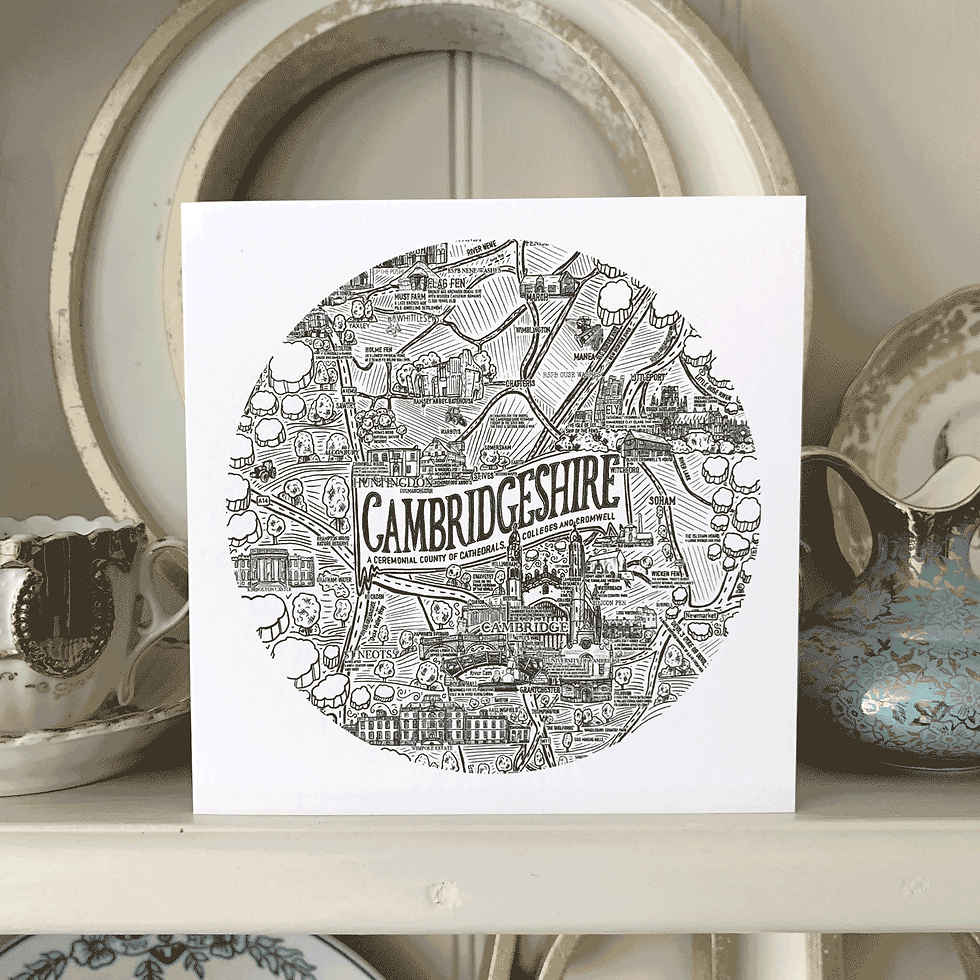
Each square card measures 140 × 140 mm, is printed in the UK on a beautiful 300gsm Arena Extra White Rough card, so it's really textured and feels lovely to the touch. It's left blank inside for your thoughtful message, and supplied with a brown craft envelope. It works for birthdays, weddings, thank-yous, new homes or simply sending a heartfelt note.
A Norfolk greetings card might suit someone who grew up near the Broads. A Cornwall card could bring back memories of summer holidays. A Lake District card can remind someone of favourite walks. Every design feels local, but the message is entirely yours.
The Emotional Impact
A card does more than deliver a message. It leaves something physical behind and signals real effort to the person holding it.
Lasting Value
Unlike a text that gets buried, a card takes up space. People keep them in drawers, stick them on fridges, or tuck them into books.
That permanence matters. A card written for a 30th birthday can still be read at 50, carrying your handwriting and the words you chose.
Objects tied to a moment become cues for remembering it. When someone opens a card, their limbic system—the bit that handles emotional memory—gets involved and anchors the moment.
Think about what a saved card holds onto:
Your handwriting at a certain point in your life
The exact words you used, unedited
The occasion and its date
Physical marks like ink smudges or a specific stamp
Deep Connection
Effort shows in a card. Picking one, writing, addressing, and posting it takes time that a quick message just doesn’t.
That’s the bit that makes people feel seen instead of just pinged. You can’t mass-produce a handwritten note the way you can a group text.
Studies have found greeting cards spark stronger emotional responses than emails or digital messages. Maybe it’s the context, a hand-addressed envelope stands out among bills and flyers.
Cards often show up when connection is needed most:
SituationWhat the card communicates | |
Long-distance friendship | Distance hasn’t made you forget |
Illness or loss | You’re willing to sit with difficulty |
Milestone birthday | The history you share is worth marking |
No occasion at all | The thought just popped up |
Shared Happiness
The benefit goes both ways. Writing a card gives you space to slow down and really think about someone, which feels good in itself.
Handwriting makes you pause. You reflect before you commit words to paper, and sometimes that brings up memories or feelings you hadn’t really noticed.
People often guess sending a card will feel mildly satisfying, but it usually brings more than that—sometimes even a bit of calm.
For the recipient, opening a card creates a lift. Acts of kindness trigger oxytocin and endorphins, which support warmth and social closeness.
It’s a shared moment, however small. You remember writing it; they remember reading it.
The Psychology Behind Sending Greeting Cards
When you write a card, you’re doing more than just putting words on paper. Research shows both writing and receiving a personal note can boost your mood, and most people don’t realise how much the recipient will appreciate it.
That gap matters. Sometimes, it’s the reason a card sits unwritten in a drawer.
What’s happening on both sides:
For the sender | For the recipient |
Slows you down and focuses attention on one person | Shows someone spent time, not just seconds |
Encourages you to name what you really feel | Creates a physical object to keep and reread |
Gives a small sense of completion once sent | Reinforces the feeling of being noticed |
Physical cards have a weight a digital message rarely does. In one survey, 78% of people said a physical card felt more meaningful than an electronic one, probably because you can see the effort.
Effort is the signal. Choosing a card, finding a pen, writing legibly, addressing an envelope—each step shows intent before you’ve even written a word.
There’s a memory element too. Emotional messages stick better than neutral ones, which is why people keep cards for years in shoeboxes or drawers.
Cards have done this job since the 1400s. The format’s changed, but the point—telling someone they were on your mind—hasn’t.
10+ Reasons to Send or Share a Card and Brighten Someone's Day
You don’t need a birthday or holiday to justify putting pen to paper. A card works whenever you want someone to know they’ve crossed your mind.
Here are a few reasons worth acting on:
To say thank you for a favour, a meal, or time someone gave you.
To mark a milestone, a new job, graduation, or first home.
To check in on someone going through illness, grief, or a tough patch.
To apologise properly, in a way a text just can’t.
To congratulate a friend on something small they worked hard for.
To welcome a new neighbour, colleague, or baby.
To reconnect with someone you’ve lost touch with.
To encourage before an exam, interview, or move.
To celebrate an anniversary of any kind, even quiet personal ones.
To say goodbye when a colleague leaves or a friend moves.
To send a note for no reason at all—those are often the most memorable.
Cards carry weight because they take effort. Choosing, writing, addressing, and posting all show deliberate attention.
There’s a practical side too. Unlike a message on a screen, a card sits on a shelf or fridge door, and someone can come back to it weeks later.
Think about who in your life hasn’t heard from you in a while. That’s usually the best place to start.
How to Write a Nice Message in a Card
A good card message follows a simple shape: address the person, name the occasion, add something only you could say, offer a wish for what’s next, and sign off. Once you know the five parts, a blank card feels less intimidating—it’s just about filling in the details.
Step-by-Step Formula
Every strong card message uses the same five building blocks in the same order:
PartPurposeExample | ||
Greeting | Names the recipient | "Dear Sarah," |
The Reason | States why you're writing | "Happy 40th!" |
Personal Touch | Adds a detail only you know | "Still laughing about the flat tyre in Torquay." |
Good Wish | Points toward the future | "Hope year 40 is your easiest one yet." |
Closing | Signs off warmly | "Love, Diana" |
Three to five sentences is plenty for most cards. Sympathy cards might run a bit longer; a thank-you for a small favour can be just two lines.
If you get stuck, start with the personal touch. The rest is easier to build around it.
Greeting
The greeting sets the tone for everything that comes next. "Dear" is formal and works for bosses, in-laws, or colleagues you don’t know well. "Hi" or "Hey" fits close friends and siblings.
You can even skip the salutation and open with the person’s name and an exclamation: "Jamie!"
Use the name they actually go by. If your aunt’s always been Nan to you, write Nan, not Nancy.
For couples or families, decide if you’re writing to everyone or just one person. "To the whole Smith crew" works for a housewarming; "Dear Priya" for her promotion.
Nicknames show closeness, but only use ones you’ve truly earned.
The Reason
State the occasion right away, no need for suspense here.
For a birthday, just say it: "Happy birthday!" For a wedding: "Congratulations on the wedding." If you’re thanking someone: "Thank you for the espresso machine."
Be specific about the reason. "Thank you for dinner" works, but something like "Thank you for hosting us for four nights and cooking every single meal" shows you noticed all the effort.
For sympathy cards, name the loss directly. It’s better to say, "I was so sorry to hear about your father." Avoiding the name or the word death can come off as awkward rather than sensitive.
If you’re writing just because, say so. "No occasion, I just wanted to write" is a perfectly good reason.
The Personal Touch
This is the bit that makes the card yours, not just something off a shop shelf.
Funny how often people skip this part, isn’t it?
You can pull from a few places for inspiration:
A shared memory: "I still think about the summer we repainted your kitchen twice."
Something you admire: "You're the only person I know who remembers everyone's coffee order."
Something recent: "Your talk at the conference was the best one there."
Something you’ve never said out loud: "You got me through 2019, and I’m not sure I ever thanked you for it."
Be concrete. Instead of "You're a great friend," try "You drove two hours to sit in a hospital waiting room with me."
One specific detail always beats a handful of general ones.
The Good Wish
Turn your attention to what’s ahead. Match your wish to the occasion and the person’s real situation.
For a new job: "Hope the new team is as smart as you are."
For a graduation: "Excited to see what you build next."
For an illness: "Hoping you're back on the trail soon."
Keep it realistic. Telling someone they’ll be running marathons by spring after surgery might feel more like pressure than encouragement.
For sympathy cards, a wish often works better as an offer. Try, "I'll call Sunday" or "I'm bringing dinner Thursday, no need to answer."
Specific offers are just easier to accept than a vague "let me know if you need anything."
The Closing
Your sign-off really ought to match the greeting you started with. If the card's formal, keep the closing formal too.
Warm and close: Love, All my love, Love always, Yours
Friendly: Warmly, Take care, Cheers, Thinking of you
Professional: Best, Best wishes, Sincerely, With appreciation
For friends and family, just sign your first name. If there’s any risk of confusion—like at work or for big families—pop your last name on as well.
Signing for everyone at home? Write your name and then add the rest, like: "Love, Ben, Kate, and the boys."
Try to leave a bit of space between your message and your signature. When signatures get squished, the whole card can end up looking a bit rushed.
Send a Little Piece of Somewhere Special
A handwritten message is personal. Put it inside a card that celebrates a place the recipient loves, and it becomes even more memorable.
Explore the James Illustrates shop and choose an illustrated greetings card that feels personal before you have written a word.


Comments