
Norfolk Birds: A Hand-Drawn Celebration of Norfolk Birdlife

Norfolk is a brilliant county for birds.
I know I am biased. I was born here, and I live here now. But even with that taken into account, there is something about Norfolk that makes birdlife feel close by. It is in the hedgerows, gardens, fields, reedbeds, salt marshes and wide open skies.
It is there when a blackbird lands outside the studio window. It is there when gulls wheel above the coast. It is there when a marsh harrier drifts low over the reeds, barely seeming to move its wings at all.
That is really where my Norfolk Birds Bone China Mug began.
I love birds, and I love the Norfolk coast. I spend a lot of time observing the birds that live around us, not as an expert twitcher with a life list and a telescope, but as someone who likes looking, noticing and drawing. Birds have character. They have posture. They have habits. Some are familiar and comforting. Some feel rare and slightly magical. Some are part of the background of daily life until you stop and properly look at them.
So I wanted to create a mug that celebrated that variety.
Not a definitive list of Norfolk birds. That would be almost impossible, and I am sure everyone has a favourite that has not made it on. Instead, this is a hand-drawn collection of over 30 birds that feel connected to Norfolk, the coast, the countryside and the east of England. Some are common garden visitors. Some are farmland birds. Some belong to reedbeds, marshes and winter water. Some are coastal visitors that give Norfolk its wonderful birdwatching reputation. The finished mug is a celebration of them all.
Why Norfolk is such a special county for birds
Norfolk has a rare mix of habitats.
There are shingle beaches and sandy beaches. There are tidal mudflats, salt marshes, dunes, reedbeds, rivers, broads, farmland, woodland and open countryside. Norwich is the county’s major city, but so much of Norfolk still feels rural, spacious and relatively unspoilt.
That matters for birds.
Along the coast, the landscape is constantly shifting between land, sea and sky. The mudflats and marshes attract waders and wildfowl. Reedbeds give cover to birds that are heard more often than seen. Farmland and hedgerows support familiar countryside birds. Gardens and villages bring robins, blackbirds, wrens and sparrows right up to our windows.
Then there is the light.
Norfolk has those famous big skies, especially along the north Norfolk coast. They make everything feel more open. A bird crossing the sky does not disappear behind buildings. You can watch it move. You can see its shape and flight. A marsh harrier over the reeds, a gull over the beach, a skein of geese in winter, or a starling murmuration at dusk all feel bigger because the sky gives them room.
That is one of the things I love most about Norfolk. The landscape lets you watch.
The north Norfolk coast
The north Norfolk coast was the main inspiration for this mug.
It has that wild, natural feeling I always come back to. Salt marshes, creeks, dunes, wide beaches and long views. It is beautiful, but not in a polished way. It is windswept, open and alive.
You do not have to be a serious birdwatcher to enjoy it. You can simply walk, stop, look and listen. You might notice an egret in a channel, a skein of geese overhead, a wader moving along the edge of the water, or a bird of prey quartering the marsh. Some birds are obvious. Others take time. That is part of the pleasure.
Norfolk is also full of brilliant places where birds and habitats are protected and celebrated. Cley and Salthouse Marshes, Hickling Broad and Marshes, Holme Dunes, Ranworth Broad and Marshes, Roydon Common, Snettisham, Titchwell Marsh, Buckenham and Cantley Marshes, Strumpshaw Fen, Berney Marshes, Holkham and Sculthorpe Moor all form part of a much bigger story.
They are places where people go to watch wildlife, but also places where birds have space to feed, nest, rest and migrate.
For me, the mug sits quietly within that story. It is not a field guide. It is not meant to replace binoculars or a proper day out. It is a small illustrated reminder of the birdlife that makes this part of the world so rich.

The birds featured on the mug
The Norfolk Birds Bone China Mug features over 30 hand-drawn birds.
They include dunnock, blackbird, house sparrow, robin, wren, yellowhammer, chaffinch, woodpigeon, Mediterranean gull, black-headed gull, herring gull, grey partridge, brent geese, common tern, avocet, spoonbill, reed warbler, bearded tit, bittern, long-tailed duck, great northern diver, water rail, barnacle goose, white-fronted goose, scaup, water pipit, marsh harrier, firecrest, chiffchaff, woodcock and tawny owl.
It is a real mixture.
There are birds you might see from a kitchen window. There are birds you might spot on a winter walk. There are birds that belong to reedbeds and marshes. There are birds that feel more coastal. There are birds that many people will know straight away, and a few that may send them off to look something up.
I like that.
One of the nicest things about a mug covered in illustrations is that it invites a bit of looking. You turn it round. You spot one bird, then another. You find the robin. Then the blackbird. Then perhaps the marsh harrier, the spoonbill or the avocet. It becomes a small moment of discovery while you are waiting for the kettle to boil.
That was very much the idea.

Blackbirds at the studio window
My personal favourite bird on the mug is the blackbird.
I watch them from my studio window. They are not rare. They are not showy in the way some birds are. But they are full of character. There is something very satisfying about the way a blackbird moves across a lawn or appears suddenly in a hedge. They feel close to home.
That is one of the reasons I wanted the mug to include familiar birds as well as more unusual ones.
It would have been easy to fill it only with the more dramatic coastal and wetland species. But Norfolk birdlife is not only about rare sightings. It is also about the birds we live alongside every day. Robins, blackbirds, chaffinches, wrens, sparrows and chiffchaffs are part of the county’s sound and movement too.
For a lot of people, birds become meaningful because they are familiar.
A robin in the garden. A blackbird singing. A chaffinch in a hedge. A wren darting low and fast. These are the birds that make people stop for a second, even if they would never call themselves birdwatchers.
That felt important to include.

Marsh harriers on the wing
If I had to choose the bird that's special to see, it would be the marsh harrier.
I see them on the wing, and there is always something thrilling about it. Low over the reeds. Slow, steady, watchful. They have that unmistakable floating flight that makes you stop and follow them with your eyes.
A marsh harrier gives the Norfolk coast a bit of drama.
It is one of those birds that even a beginner can enjoy. You do not need to know everything about it. You just need to see it moving over the marsh and you understand why people get excited.
That is the balance I wanted in the mug. Some birds are there because they are familiar and loved. Some are there because they say something about Norfolk’s habitats. Some are there because they are special and a delight to spot. The marsh harrier is definitely that.
A few favourite birds from the design
There are too many birds on the mug to write about each one properly here, and I am not pretending to be an expert. But there are a few that help tell the story of Norfolk’s birdlife.

Robin
The robin is probably one of Britain’s most loved birds. It is familiar, bold and easy to recognise. It also brings a sense of friendliness to the mug. Almost everyone has a robin story, even if it is just one hopping around while they garden.
Chaffinch
The chaffinch is another familiar bird, often seen in gardens, hedgerows and woodland edges. It has lovely markings and a shape that works well as an illustration. It is the sort of bird that rewards a second look.
Chiffchaff
The chiffchaff is small, understated and easily missed by sight, but its name gives away its song. I liked including it because it represents those birds that are part of the sound of a place as much as the look of it.
Avocet
The avocet brings elegance. With its long legs and upturned bill, it has such a distinctive silhouette. It feels perfectly at home in a design inspired by wetlands, waders and open water.
Spoonbill
The spoonbill is one of those birds that seems almost designed to make people look twice. That bill is so distinctive. It adds a little surprise to the mug and helps show the variety of birdlife associated with Norfolk.
Scaup
I wanted to include some less obvious birds too, and scaup helps with that. It adds to the sense that this is not just a collection of the most famous birds, but a broader celebration of birds you might connect with the coast and wetland landscapes of the east.
Tawny owl
The tawny owl brings a different mood altogether. Not coastal, not marshy, but part of the wider countryside. Owls always carry a bit of mystery, and they sit nicely alongside the more everyday birds in the design.
Murmurations, dusk and looking up
One of my favourite birdwatching memories is watching a murmuration of starlings at dusk.
It is hard not to be transfixed by it. The way the birds move together, turn together, darken and loosen and tighten in the sky. It is one of those natural spectacles that feels both familiar and completely strange at the same time.
That is part of what keeps me interested in birds.
You can enjoy them at any level. You can know a huge amount, or you can simply stand still and watch. You can visit a reserve with a purpose, or you can look out of a window while holding a cup of tea. Birds are democratic like that. They are there for anyone who notices.
That is also why they work so well as illustrations. Each bird is small, but each has a presence. A posture. A pattern. A character. Drawn together, they become a picture of a place.
How I illustrated the birds
Each bird was drawn by hand by me on an iPad using a digital pencil.
My research was a mixture of desk research and simply being outside. I looked at field guides, photographs, sketches and reference material, but I also drew from time spent in the landscape. I wanted the birds to feel recognisable, but not like scientific plates. They are illustrations, not identification charts.
The aim was a general likeness.
I wanted each bird to have enough detail to feel right, but also to sit comfortably within my black and white style. That means thinking about markings, outline, pose and how the birds work together as a pattern around the mug.
The poses matter too.
If every bird faced the same way or stood in the same position, the design would feel flat. So I looked for variety. Some birds are side-on. Some feel alert. Some are quieter. Some have a stronger shape. Together, they create a design that keeps moving as you turn the mug in your hand.
That is the hidden part of a product like this. A mug can feel simple when it is finished, but there is a lot of drawing, arranging and adjusting behind it. It takes time to make the collection feel balanced. It takes time to make sure the design is busy but not messy, detailed but still clear.
I draw what I like, in the style I naturally draw in, and hope other people like it too.
That is probably the simplest way to explain it.
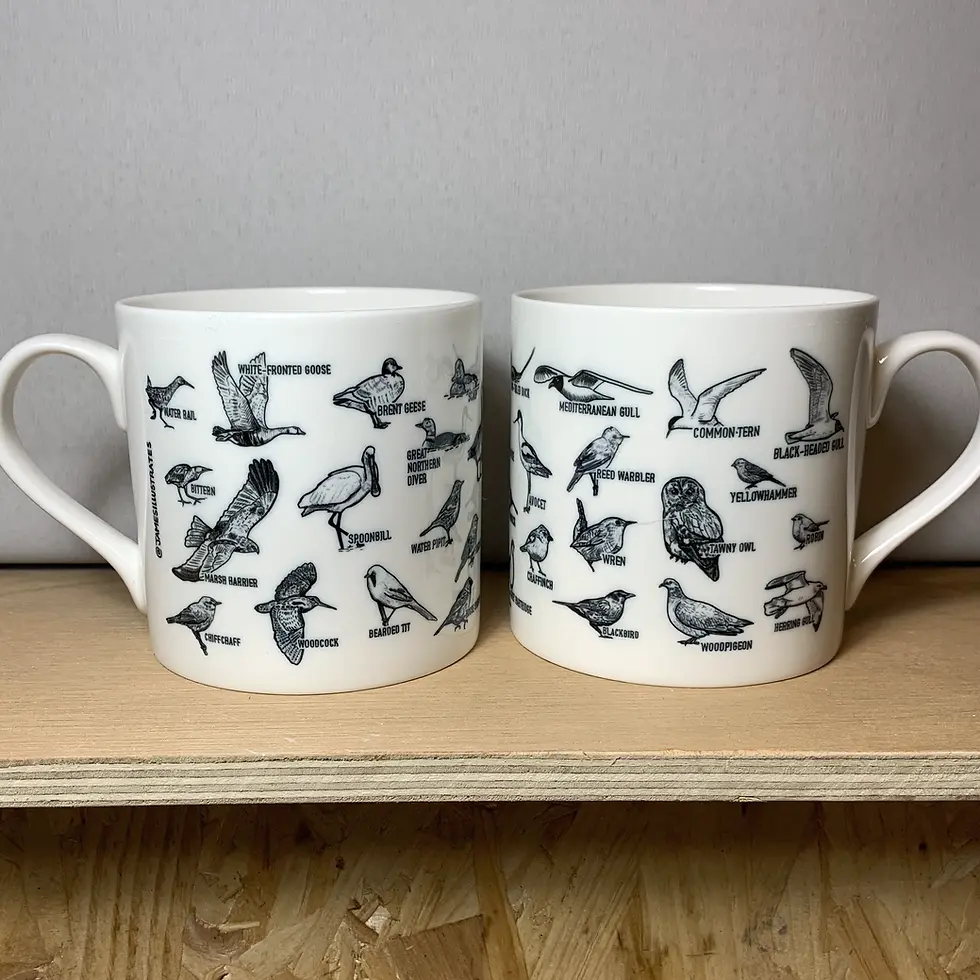
The Norfolk Birds Bone China Mug
The finished mug is called the Norfolk Birds Bone China Mug.
It is a large straight-sided Balmoral bone china mug, measuring 9cm by 9cm. The illustration is finished in the UK, and the mug is dishwasher and microwave safe. It is made to be used, not just displayed.
That was important to me.
I like beautiful things, but I like them even more when they become part of everyday life. A favourite mug should not sit at the back of a cupboard waiting for a special occasion. It should be used for tea, coffee, something herbal, or whatever gets you through the day.
This one is big enough for a proper drink. It is also big enough for a biscuit dunk, which is obviously vital.
The mug is priced at £19.50 and produced in small batches. I am not importing thousands of printed mugs. These are made in smaller numbers by me as part of the James Illustrates Norfolk collection.
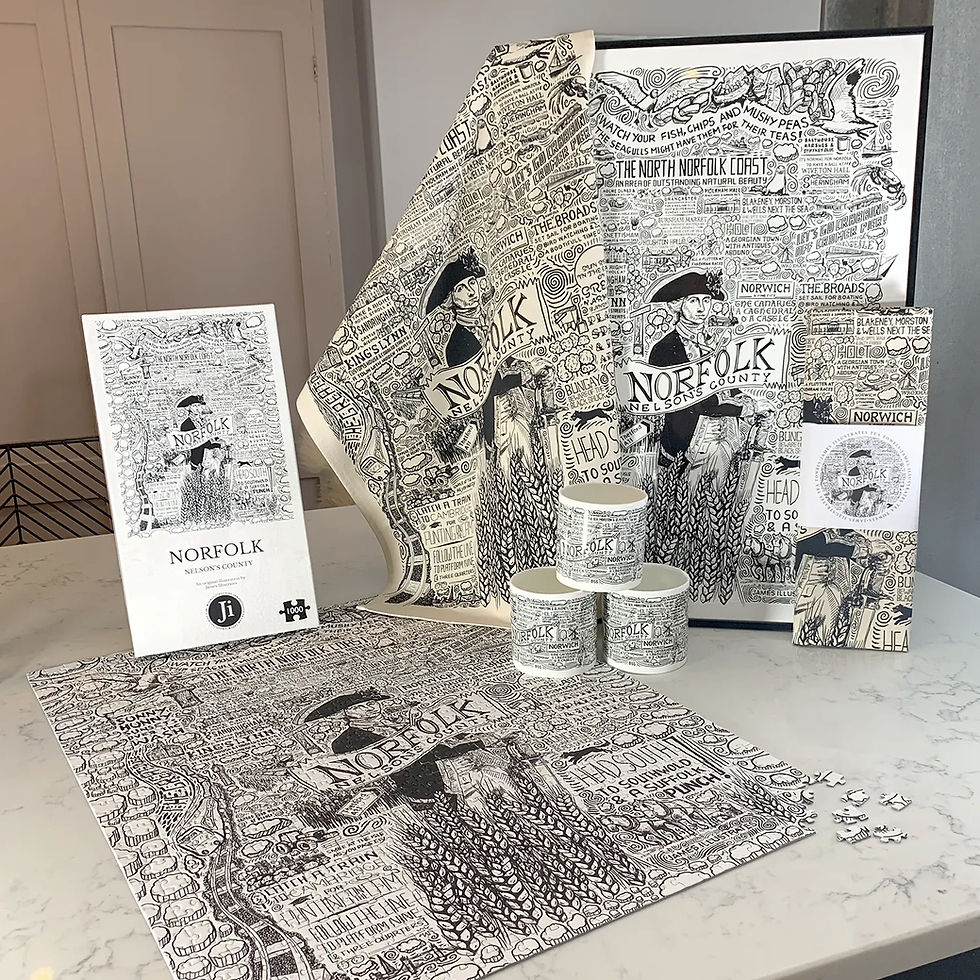
That collection also includes my Norfolk tea towel, art prints and 1000-piece jigsaw puzzle. So if you are putting together a Norfolk-themed gift, or already have one of my Norfolk pieces, this mug sits very happily alongside them.
A gift for bird lovers, Norfolk lovers and dads who like a proper mug
I imagine this mug being bought by people who love birds, people who love Norfolk, and people who enjoy the landscapes of the east coast.
It could be for a birdwatcher. It could be for someone who holidays in Norfolk every year. It could be for someone who grew up here and misses the coast. It could be for someone who likes garden birds, long walks, big skies, nature reserves, or simply a good mug with lots to look at.
I also think it makes a very good gift for dads.
Not just for Father’s Day, although it would be perfect for that. But for birthdays, Christmas, thank you presents, or those slightly difficult people who say they do not need anything, but still quite enjoy receiving something thoughtful.
The nice thing about the design is that it gives people something to discover.
When you open the box, you do not see everything at once. You turn the mug and look for favourites. You spot the robin, the blackbird, the marsh harrier, the avocet. You wonder if a particular bird is there. You notice another one later. It becomes a talking point.
That is what I hoped for.
A small celebration of a very bird-rich county
Norfolk’s birds are one of the things that make the county feel so alive.
They are part of the garden, the coast, the marsh, the field and the evening sky. Some are everyday companions. Some are seasonal visitors. Some are spectacular. Some are quiet and easily missed. Together, they help make Norfolk feel like Norfolk.
This mug is my small illustrated celebration of that.
It is not a complete guide. It is not a scientific list. It is not trying to be the final word on Norfolk birdlife. It is simply a collection of birds I enjoyed drawing, inspired by a county I love, and made for people who enjoy birds, Norfolk and a good cup of tea.
You can find the Norfolk Birds Bone China Mug in my Norfolk collection now.
And if this one goes well, there may be more county bird mugs to come.
FAQs
Is Norfolk good for birdwatching?
Yes. Norfolk is one of the best places in the UK for birdwatching, thanks to its varied habitats, including coast, salt marsh, reedbeds, broads, farmland, woodland and wetlands.
What birds are featured on the Norfolk Birds Bone China Mug?
The mug features over 30 hand-drawn birds, including blackbird, robin, chaffinch, chiffchaff, marsh harrier, avocet, spoonbill, bittern, bearded tit, brent geese, reed warbler, tawny owl, scaup and many more.
Is the Norfolk Birds mug dishwasher safe?
Yes. The mug is dishwasher safe and suitable for everyday use.
Is the mug microwave safe?
Yes. The Norfolk Birds Bone China Mug is microwave safe.
Is this a good gift for birdwatchers?
Yes. It makes a thoughtful gift for birdwatchers, Norfolk lovers, walkers, gardeners, dads, nature lovers and anyone who enjoys British birds.
Is the mug part of a wider Norfolk collection?
Yes. The mug sits alongside the James Illustrates Norfolk collection, which includes art prints, a tea towel and a 1000-piece jigsaw puzzle.


Comments